
10. String Security
Strings
Character Strings
- 표준 C 라이브러리 지원
char타입의 stringswchar_t타입의 wide strings
Figure 2.1. "hello"의 문자열 표현
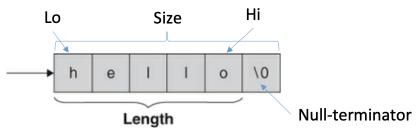
An Example
- size of an array
void clear(int array[]) {
  for (size_t i = 0; i < sizeof(array) / sizeof(array[0]); ++i) {
    array[i] = 0;
  }
}

void dowork(void) {
  int dis[12];

  clear(dis);
  /* ... */
}
multibyte character set
- Basic execution character set
- 26개의 대문자, 26개의 소문자 등
- UTF-8
- A multibyte character set
- Backward compatible
- 1 ~ 4 bytes
- String literals
L"xyz"- Type
wchar_t
Strings
const char s[3] = "abc";- Array의 크기는 3
- Trailing null byte는 생략
const char s[ ] = "abc";
Strings in C++
std::basic_string- Characters의 시퀀스
string은 template specializationbasic_string<char>에 대한 typedefwstring은 template specializationbasic_string<wchar_t>에 대한 typedef
- C++ string class
- 모든 일반적인 implementation은 null-terminated
- Win32
LSA_UNICODE_STRING과 같은 일부 다른 string type은 null-terminated일 필요는 없음.
Character Types
- three types
char,signed char,unsigned char
- Philosophy
- Signed char and unsigned char
- 작은 정수값에 적합
- Plain char
- 문자열 리터럴의 각각 요소들의 타입
- 정수 데이터 대신 문자(character) 데이터를 위해 사용 (부호의 의미가 적은)
- Signed char and unsigned char
- Example
size_t len;
char cstr[] = "char string";
signed char scstr[] = "signed char string";
unsigned char ucstr[] = "unsigned char string";

len = strlen(cstr);
len = strlen(scstr); /* warns when char is unsigned */
len = strlen(ucstr); /* warns when char is signed */
int
EOF(음수 값)- 또는
unsigned char로 해석된char data int를 반환하는 함수fgetc(),getc(),getchar(),fgetwc(),getwc(),getwchar()
<ctype.h>에 선언된 char classification functionsint를 인수로 허용- 예:
isalpha()
Example
- Code Example 분석
int main() { char c = 'a'; char b[] = “a”; wchar_t wc; printf(" size of 'a': %d \n", sizeof('a')); printf(" size of c: %d \n", sizeof(c)); printf(" size of wc: %d \n", sizeof(wc)); } - C에서 sizeof('a') → ???, sizeof(c) → ???
- C++에서 sizeof('a') → ???
unsigned char
- 객체가 어떤 type이든 될 수 있을 때 유용
fwrite()- Pure binary notation을 사용하여 표현됨이 보장
- Example
int main() {
    unsigned char buf1[6] = { 0xff, 0x56, 0x78, 0xfa, 0xf1, 0};
    unsigned char buf2[6];
    FILE *stream;
    stream = fopen(“out.dat”, “wb”);
    fwrite(buf1, sizeof(char), 6, stream);
    fclose(stream);
    stream = fopen(“out.dat”, “rb”);
    fread(buf2, sizeof(char), 6, stream); fclose(stream);
    for (int i=0; i<6 && buf2[i] != NULL; i++)
        printf(“%x “, buf2[i]);
    printf(“\n”);
    return 0;
}
Sizing Strings
- Buffer overflows를 예방하기 위해 필수
- The CERT C Secure Coding Standard
STR31-C. strings용 저장 공간이 character data와 null terminator를 위한 충분한 공간을 갖도록 보장
- 용어
- Size: array에 할당된 byte 수 (
sizeof(array)와 동일) - Count: array의 element 수 (Visual Studio 2010의
_countof(array)와 동일) - Length: null terminator 앞의 character 수 (
strlen()결과)
- Size: array에 할당된 byte 수 (
- Example
wchar_t wide_str1[] = L”0123456789”;
wchar_t *wide_str2 = (wchar_t *) malloc (strlen(wide_str1) +1);
if (wide_str2 == NULL) {
  /* handle error */
}
strcpy(wide_str2, wide_str1);
/* … */
free(wide_str2);
wide_str2 = NULL;
Common String Manipulation Errors
- 4가지 일반적인 오류
- unbounded string copies (무한 string 복사)
- off-by-one errors
- null-termination errors
- String truncation
- String truncation
Improperly Bounded String Copies
- 데이터가 고정된 길이의 문자열로부터 복사될 때
- 예: 고정된 길이 버퍼에 표준 입력으로 읽어오는 경우
gets()C99에 추가되었으나C11에서 제거- "STR35-C. unbounded source에서부터 고정 길이 배열에 복사하지 마시오."
#include <stdio.h>
#include <stdlib.h>

void get_y_or_n(void) {
  char response[8];
  puts("Continue? [y] n: ");
  gets(response);
  if (response[0] == 'n')
    exit(0);
  return;
}
Example 2.1. Reading from
stdin()
Copying and concatenating strings
Improperly Bounded String Copies
- Standard lib functions
strcpy(),strcat(),sprintf()
int main(int argc, char *argv[ ]) ...argv[0]~argv[argc-1]: Null-terminated string을 가리키는 pointerargvarray의 어떤 요소도(argv[0]포함) null이 아니라고 가정하지 말 것
int main(int argc, char *argv[]) {
    /* Do not assume that argv[0] can-
    not be null */
    const char * const name =
    argv[0] ? argv[0] : "";
    char *prog_name = (char *)mal-
    loc(strlen(name) + 1);
    if (prog_name != NULL) {
        strcpy(prog_name, name);
    }
    else {
        /* Failed to allocate memory -
    recover */
    }
    /* ... */
}
sprintf() function
- array에 output을 작성
- 작성된 character의 끝에 null character가 작성
- target array에 필요한 최대 크기를 결정하기 어려움
- 예:
INT_MAX→ 최소 11 characters - 음의 정수, floating-point values는 예측이 더 어려움
- 예:
snprintf()함수- 추가 parameter:
size_t n - null char가 추가되므로 characters가 작성
- 성공 시 작성된 character 수 (excluding null char) 반환
- 비교적 안전하지만, format string vulnerabilities에 취약
- 추가 parameter:
C++의 std::cin
- 이 또한 문제점 있음.
#include <iostream>

int main(void) {
  char buf[12];

  std::cin >> buf;
  std::cout << "echo: " << buf << '\n';
}
- field width를
ios_base::width또는setw()로 설정 가능 - characters가 추출된 후 null character가 자동으로 추가됨
#include <iostream>

int main(void) {
  char buf[12];

  std::cin.width(12);
  std::cin >> buf;
  std::cout << "echo: " << buf << '\n';
}
Off-by-One Errors
- 또 다른 일반적인 문제
- unbounded string copies와 유사
- Example
#include <string.h>
#include <stdio.h>
#include <stdlib.h>

int main(void) {
  char s1[] = "012345678";
  char s2[] = "0123456789";
  char *dest;
  int i;

  strcpy_s(s1, sizeof(s2), s2);
  dest = (char *) malloc (strlen(s1));
  for (i = 1; i <= 11; i++) {
    dest[i] = s1[i];
  }
  dest[i] = '\0';
  printf("dest = %s", dest);
  /* ... */;
}
Null-Termination Errors
- Example
int main(void) {
  char a[16];
  char b[16];
  char c[16];
  strncpy(a, "0123456789abcdef", sizeof(a));
  strncpy(b, "0123456789abcdef", sizeof(b));
  strncpy(c, a);
  /* ... */
}
strncpy()는 처음 characters를 복사- Null-termination을 보장하지 않음.
String Vulnerabilities and Exploits
- C 또는 C++에서 String manipulation
- 외부 source의 untrusted data에서 작동할 때 위험해짐
- 모든 외부 데이터를 untrusted로 보는 것이 안전
- Example
bool IsPasswordOK(void) {
  char Password[12];

  gets(Password);
  return 0 == strcmp(Password, "goodpass");
}

int main(void) {
  bool PwStatus;

  puts("Enter password: ");
  PwStatus = IsPasswordOK();
  if (PwStatus == false) {
    puts("Access denied");
    exit(-1);
  }
}
Buffer Overflows
- Example
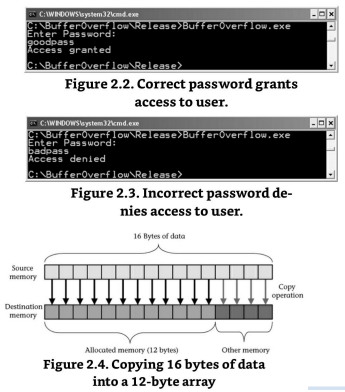
- C 및 C++가 buffer overflows에 취약한 이유
- Strings를 null-terminated arrays of characters로 정의
- 암묵적인 bounds checking을 수행하지 않음.
- Bounds checking을 강제하지 않는 strings에 대한 표준 라이브러리 호출 제공
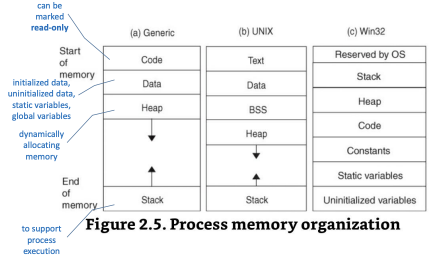
Process Memory Organization
Programs and Processes
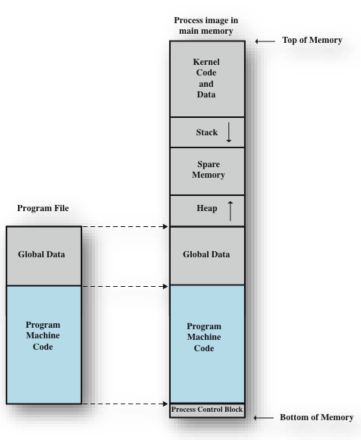
Figure 10.4 Program Loading into Process Memory
Stack Buffer Overflows
- Buffer가 stack에 위치할 때 발생
- Stack smashing이라고도 함
- Morris Worm에 의해 사용
- exploits는 unchecked buffer overflow를 포함
- 여전히 널리 악용되고 있음.
- Stack frame
- 한 함수가 다른 함수를 호출할 때 return address를 저장할 공간 필요
- 호출된 함수에 전달될 parameters와 register values를 저장할 위치도 필요
Stack Frame with Functions P and Q
  ┌───────────────────┐
P:│    Return Addr    │
  ├───────────────────┤
  │ Old Frame Pointer │◄──┐
  ├───────────────────┤   │
  │      param 2      │   │
  ├───────────────────┤   │
  │      param 1      │   │
  ├───────────────────┤   │
Q:│ Return Addr in P  │   │
  ├───────────────────┤   │
  │ Old Frame Pointer │◄──┴─────── Frame
  ├───────────────────┤            Pointer
  │      local 1      │
  ├───────────────────┤
  │      local 2      │◄────────── Stack
  ├───────────────────┤            Pointer
  │         │         │
  │         ▼         │
Figure 10.3 Examples Stack Frame with Functions P and Q
Stack Management
- Stack은 automatic process-state data를 유지하여 program execution을 지원
Figure 2.6. Stack management
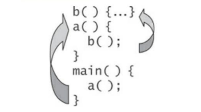
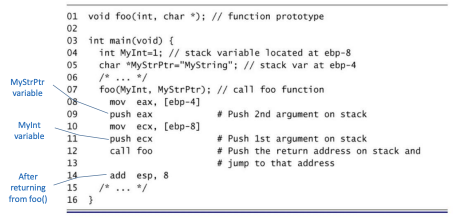
- Stack frame의 정보
- return address
- local variables
- frame pointer
- (Disassembly using Intel Notation)
foo()함수 prologue
void foo(int i, char *name) {
    char LocalChar[24];
    int LocalInt;
    push ebp        # Save the frame pointer.
    mov ebp, esp    # Frame pointer for subroutine is set to the
                    # current stack pointer.
    sub esp, 28     # Allocates space for local variables.
    /* ... */
foo()함수 Epilogue
/* ... */
return;
    mov  esp, ebp   # Restores the stack pointer.
    pop  ebp        # Restores the frame pointer.
    ret             # Pops the return address off the stack
                    # and transfers control to that location.
}
foo()호출 후 Stack frame
| Address | Value | Description (설명) | Length |
|---|---|---|---|
0x0012FF4C | ? | 마지막 local variable—integer: LocalInt | 4 |
0x0012FF50 | ? | 첫 번째 local variable—string: LocalChar | 24 |
0x0012FF68 | 0x12FF80 | 호출 함수 main()의 calling frame | 4 |
0x0012FF6C | 0x401040 | 호출 함수 main()의 return address | 4 |
0x0012FF70 | 1 | 첫 번째 argument: MyInt (int) | 4 |
0x0012FF74 | 0x40703C | 두 번째 argument: pointer toMyString (char *) | 4 |
Stack Smashing
- Stack smashing
- Buffer overflow가 execution stack에 할당된 메모리의 데이터를 덮어쓸 때 발생
- Stack segment의 buffer overflow는 공격자가 arbitrary code를 실행하도록 유도 가능
- Example
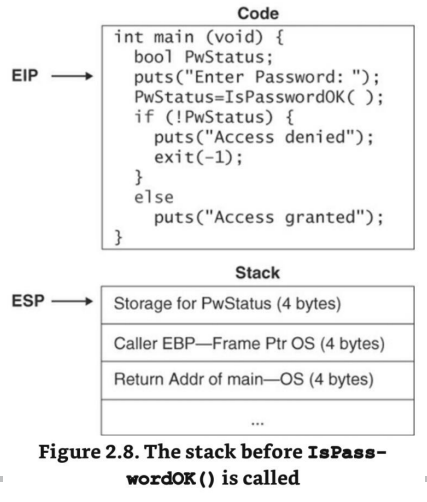
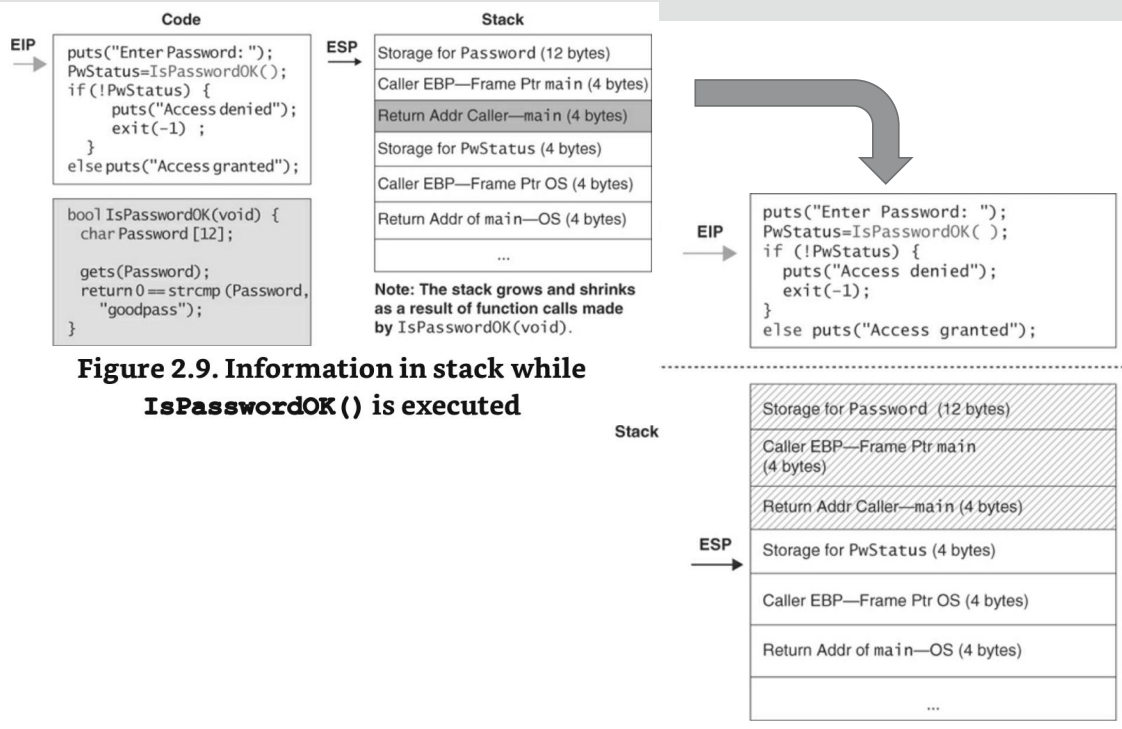
Corrupted program stack
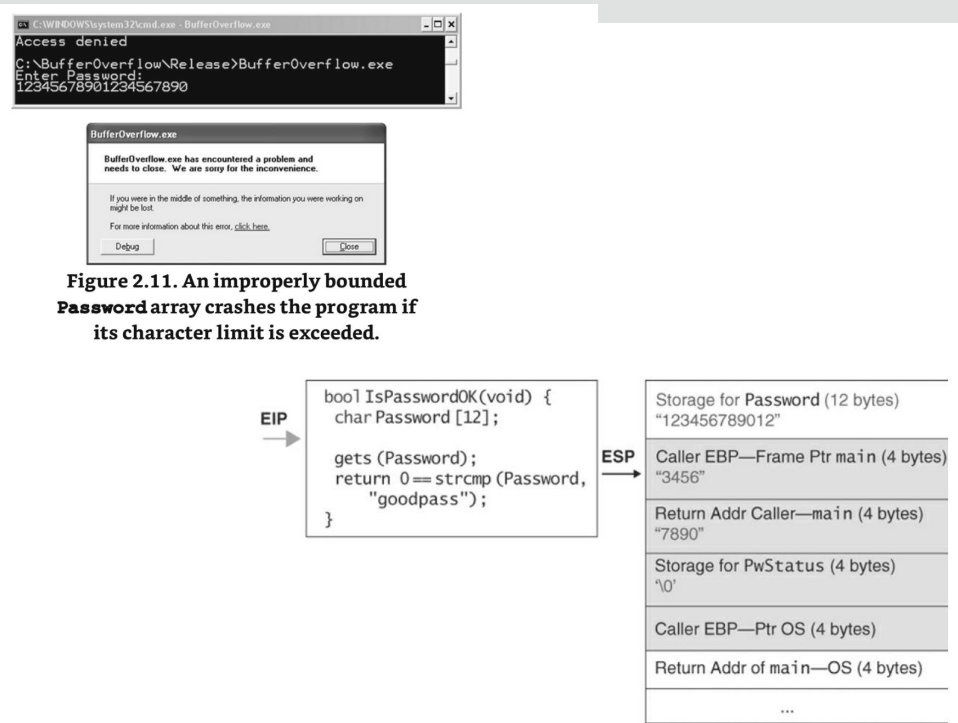
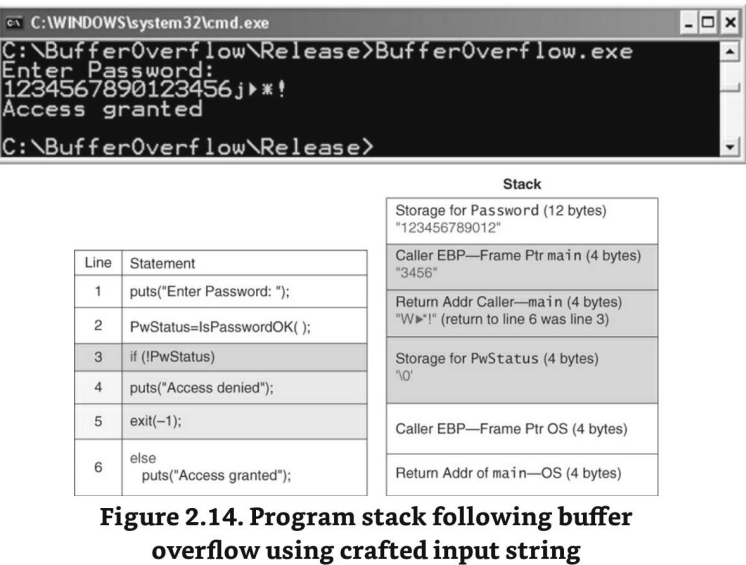
- Carefully crafted input string
j = 0x6A,= 0x10,* = 0x2A,! = 0x21
Code Injection
- Return address가 덮어쓰여질 때
- 제어 흐름을 새 주소로 전달하는 것은 일반적으로 trap을 유발하고 corrupted stack을 초래
- 공격자가 악성 code에 대한 pointer를 포함하는 specially crafted string을 생성하는 것이 가능
- 악성 code는 취약한 program이 가진 권한으로 실행
- Malicious arguments
- 취약한 program에 의해 legitimate input으로 수용되어야 함
- 다른 제어 가능한 입력과 함께 인수가 취약한 code path의 실행을 초래해야 함
- Shellcode로 제어가 전달되기 전에 인수가 program을 비정상적으로 종료시키지 않아야 함
- Example
./BufferOverflow < exploit.bin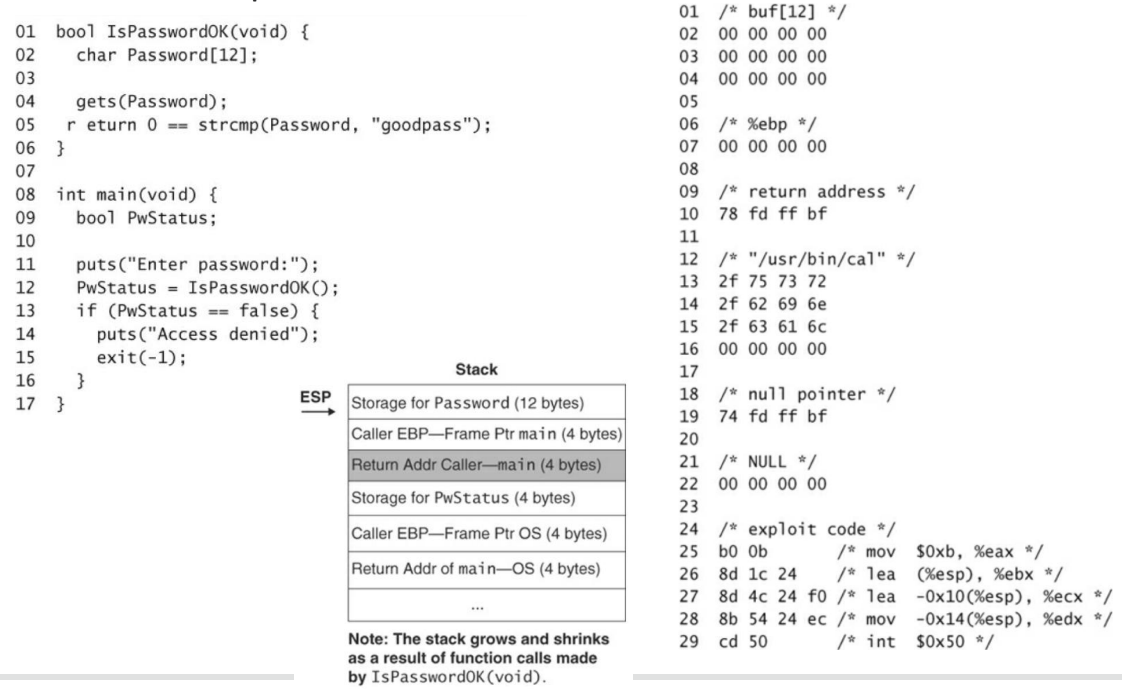
- 첫 번째
movinstruction은 %eax register에0xB할당 execve()함수 호출을 위한 세 인수는 후속 세 instructions에서 설정int $0x50instruction은execve()를 호출하여 Linux calendar program을 실행
Modified Example
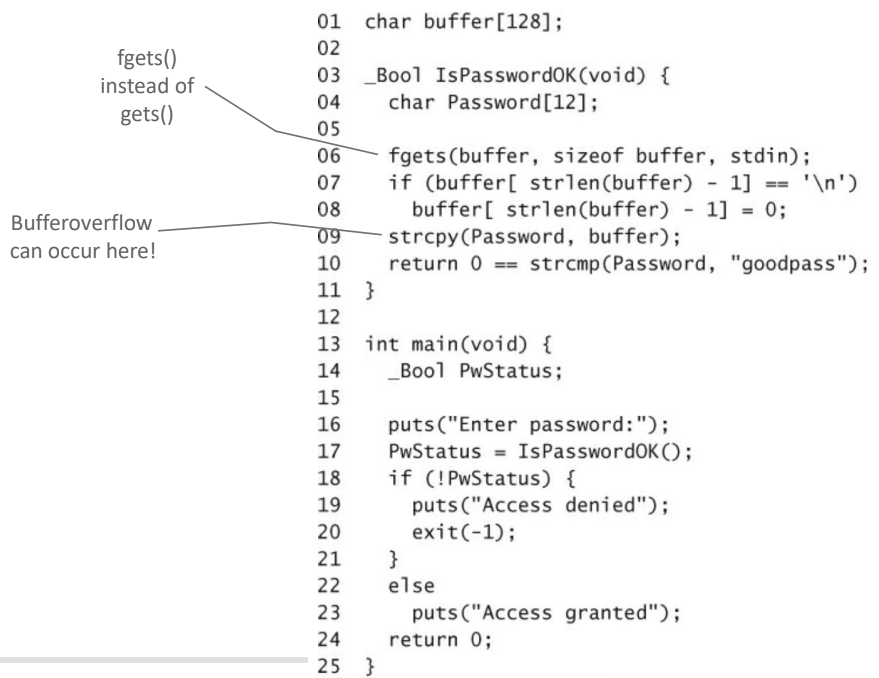
gets()대신fgets()사용- Buffer overflow가 여전히 발생할 수 있음.
- Modified Example
- Exploit Code

- Corrupted Stack
- Exploit Code
| Row | Address | Content | Description |
|---|---|---|---|
| 1 | 0xbffff9c0 -0xbffff9cf | "123456789012456" | Password(16 bytes) 및 padding을 위한 저장 공간 |
| 2 | 0xbffff9d0 -0xbffff9db | "789012345678" | 추가 padding |
| 3 | 0xbffff9dc | (0xbffff9e0) | 새로운 return address |
| 4 | 0xbffff9e0 | xor %eax,%eax | eax를 0으로 설정 |
| 5 | 0xbffff9e2 | mov %eax,0xbffff9ff | Null pointer로 pointer array 종료 |
| 6 | 0xbffff9e7 | mov $0xb,%al | execve() function call을 위한 code 설정 |
| 7 | 0xbffff9e9 | mov $0xbffffa03,%ebx | execve()의 첫 번째 argument를 가리키도록 ebx 설정 |
| 8 | 0xbffff9ee | mov $0xbffff9fb,%ecx | execve()의 두 번째 argument를 가리키도록 ecx 설정 |
| 9 | 0xbffff9f3 | mov 0xbffff9ff,%edx | execve()의 세 번째 argument를 가리키도록 edx 설정 |
| 10 | 0xbffff9f9 | int $80 | execve() system call 호출 |
| 11 | 0xbffff9fb | 0xbffff9ff | 새 program에 전달되는 argument string들의 array |
| 12 | 0xbffff9ff | "1111" | Pointer array를 종료하기 위해 0x00000000으로 변경 및 세 번째 argument로 사용 |
| 13 | 0xbffffa03 -0xbffffa0f | "/usr/bin/cal\0" | 실행할 command |
Arc Injection
- Arc injection technique
- 이미 process memory에 존재하는 code로 제어를 전달
- 새로운 arc (control-flow transfer) 삽입
system()또는exec()을 사용하여 commands 실행 가능- 여러 함수를 순차적으로 호출 가능
- 공격자가 code injection보다 arc injection을 선호할 수 있는 이유
- 대상 시스템의 메모리에 이미 code가 존재
- Footprint를 현저히 작게 유지 가능
- Memory-based protection schemes로 보호할 수 없음.
- Example
#inclue <string.h>

int get_buff(char *user_input, size_t size) {
    char buff[40];
    memcpy(buff, user_input, size);
    return 0;
}

int main(void) {
    /* ... */
    get_buff(tainted_char_array, tainted_size);
    /* ... */
}
Mitigation Strategies
- 여러 전략을 결합하는 defense-in-depth tactic 채택
- String handling에 대한 secure technique
- 하나 이상의 runtime detection
- String handling
- Character strings 처리에 대한 단일 접근 방식 선택 권장
- Character strings 처리에 대한 단일 접근 방식 선택 권장
- String-handling functions는 메모리 관리 방식에 따라 분류
- Caller allocates, caller frees (
C99,OpenBSD,C11Annex K) - Callee allocates, caller frees (
ISO/IEC TR 24731-2) - Callee allocates, callee frees (
C++std::basic_string)
- Caller allocates, caller frees (
C11 Annex K Bounds-Checking
- 첫 번째 메모리 관리 model (caller allocates하고 caller free하는 방법)
C11Annex K- 대안적인 라이브러리 함수 제공
- output buffers가 의도한 결과를 담을 만큼 충분히 큰지 확인
- 충분하지 않으면 failure indicator 반환
- 모든 string results는 null-terminated
- 예:
strcpy_s(),strcat_s(),strncpy_s(),strncat_s(), ... 정의 ISO/IEC TR 24731-1로 게시 → 나중에C11에 optional extensions 세트로 통합__STDC_LIB_EXT1__macro 정의 필요C11Annex K는 normative이지만 optimal annexgcc에서는 implemented되지 않음.- 유효하지 않은 크기가 함수에 전달되면 buffer overflow problems를 겪을 수 있음.
C11 Annex K
- Example:
gets_s()
#define __STDC_WANT_LIB_EXT1__ 1
#include <stdio.h>
#include <stdlib.h>

void get_y_or_n(void) {
    char response[8];
    size_t len = sizeof(response);
    puts("Continue? [y] n: ");
    gets_s(response, len);
    if (response[0] == n)
        exit(0);
}
Runtime-constraint-handler function
- 오류 감지 시 특수 runtime-constraint-handler function 호출
- 오류 메시지 출력 및/또는 program 중단 가능
set_constraint_handler_s()함수를 통해 호출되는 handler function 제어 가능- "
ERR03-C. Use runtime-constraint handlers when calling functions defined by TR24731-1"- Implementation-defined behavior를 제거하기 위해 runtime-constraint handler 설치 권장
C11 Annex K
- Example 2.6.
gets_s()(Improved)
#define __STDC_WANT_LIB_EXT1__ 1
#include <stdio.h>
#include <stdlib.h>

void get_y_or_n(void) {
    char response[8];
    size_t len = sizeof(response);

    puts("Continue? [y] n: ");
    if ((gets_s(response, len) == NULL) || (response[0] == 'n')) {
        exit(0);
    }
}

int main(void) {
    constraint_handler_t oconstraint = set_constraint_handler_s(ignore_handler_s);
    get_y_or_n();
}
Runtime-constraint-handler function
ignore_handler_s()함수로 설정된 경우- 모든 위반은 caller에게 반환
- 대부분의 bounds-checking functions는 nonzero
errno_t반환gets_s()함수는 null pointer 반환 (compatibility를 위해)
- "
ERR00-C. 일관되고 포괄적인 오류 처리 정책을 채택하고 시행" - Original constraint handler
- 라이브러리 함수가 constraint handler를 설정하는 경우, 함수는 반환 또는 종료 전에 original constraint handler를 복원해줘야 함
Dynamic Allocation Functions
- 두 번째 메모리 관리 model (callee allocates, caller frees)
ISO/IEC TR 24731-2ISO/IEC TR 24731-2
- 이러한 함수 사용은 나중에 buffers를 free하기 위한 추가 호출이 필요
ISO/IEC TR 24731-2에 설명된 함수는 버퍼가 항상 필요한 데이터를 담을 수 있도록 자동 크기 조정 → 더 큰 보장 제공- Denial-of-service attacks를 겪을 수 있음.
#define __STDC_WANT_LIB_EXT1__ 1
#include <stdio.h>
#include <stdlib.h>

void get_y_or_n(void) {
    char response[8];
    size_t len = sizeof(response);

    puts("Continue? [y] n: ");
    if ((getline(&response, &len, stdin) < 0) || (len && response[0] == 'n')) {
        free(response);
        exit(0);
    }
    free(response);
}
- Example:
getline()- Buffer를 dynamically allocate
- Buffer를
free해야 함
String stream
fmemopen(),open_memstream()- 함수 prototypes
FILE *fmemopen(
    void * restrict buf, size_t size, const char * restrict mode
);
FILE *open_memstream(
    char ** restrict bufp, size_t * restrict sizep
);
)
open_memstream()에 의해 열린 stream의 경우- write operations를 수용하기 위해 메모리 영역이 dynamically 증가
- Caller는 할당된 메모리를 free해야 함 (line 16)
- Dynamic allocation은 safety-critical systems에서 종종 허용되지 않음.
- Example
#include <stdio.h>

int main(void) {
    char *buf;
    size_t size;
    FILE *stream;

    stream = open_memstream(&buf, &size);
    if (stream == NULL) { /* handle error */ };
    fprintf(stream, "hello");
    fflusth(stream);

    printf("buf = '%s', size = %zu\n", buf, size);
    fprintf(stream, ", world");
    fclose(stream);
    printf("buf = '%s', size = %zu\n", buf, size);
    free(buf);
    return 0;
}
C++ std::basic_string
- C++ extraction operator
operator>>- Field width를 설정하여 buffer overflow vulnerability 제거
- Truncation 문제
- 예상치 못한 program behavior가 발생할 수 있음.
- ISO/IEC 14882에 정의된 표준
std::string class- type
char에 대한std::basic_string template의 specialization
- type
basic_string class- Strings에 대한 dynamic approach 사용
- "callee allocates, callee frees" 메모리 관리 전략 → 가장 안전한 접근 방식
- Example
string str1 = “hello, “;
string str2 = “world”;
string str3 = str1 + str2;
Example: std::cin
#include <iostream>
#include <string>
using namepsace std;

int main(void) {
    string str;

    cin >> str;
    cout << "str 1: " << str << '\n';
}
std::out_of_range
- Subscript member
std::string::operator[]- Exception을 던지지 않음.
- Example
string bs(“01234567”);
size_t i = 10;
bs[i] = ‘\0’;
at()methodoperator[]와 유사하지만,pos >= size()이면 out_of_range exception 발생
- Example
string bs("01234567");
try {
    size_t i = f();
    bs.at(i) = '\0';
}
catch (out_of_range& oor) {
    cerr << "Out of Range error: " << oor.what() << '\n';
}
c_str()
string을 null-terminated byte string으로 변환c_str()method- Example
string str(“abcd”);
cout << strlen(str.c_str());
String-Handling Functions
gets()- 절대
gets()함수 호출 금지 - 종료 newline 또는
EOF가 발견될 때까지 표준 입력에서 buffer로 한 줄을 읽음. C11에서 제거C11에서 제거
- 절대
- 대체 함수
C99fgets()getchar()
fgets()
char buf[LINE_MAX];
int ch;
char *p;

if (fgets(buf, sizeof(buf), stdin)) {
    /* fgets succeeds, scan for newline character */
    p = strchr(buf, '\n');
    if (p) {
        *p = '\0';
    }
    else {
        /* newline not found, flush stdin to end of line */
        while (((ch = getchar()) != '\n')
            && !feof(stdin)
            && !ferror(stdin)
        );
    }
}
else {
    /* fgets failed, handle error */
}
fgets() and getchar()
fgets()- Newline character를 유지
- Truncation: 사용자 입력이 잘릴 수 있음.
- 입력할 character 수가 destination buffer의 길이보다 크면 buffer overflow 발생 가능
getchar()stdin이 가리키는 입력 stream에서 다음 character 반환- Stream이
EOF에 있거나 read error 발생 시EOF반환
getchar()
- Example 2.10.
getchar()
char buf[BUFSIZ];
int ch;
int index = 0;
int chars_read = 0;

while (((ch = getchar()) != '\n')
    && !feof(stdin)
    && !ferror(stdin))
{
    if (index < BUFSIZ - 1) {
        buf[index++] = (unsigned char)ch;
    }
    chars_read++;
} /* end while */

buf[index] = '\0'; /* null-terminate */

if (feof(stdin)) {
    /* handle EOF */
}
if (ferror(stdin)) {
    /* handle error */
}
if (chars_read > index) {
    /* handle truncation */
}
C11 Annext K gets_s()
C11gets_s()함수gets()와 호환- 더 안전한 version
stdin에서 읽음.- Newline character를 유지하지 않음.
- 오류 발생 시
- 입력 수행 안 함
- Char array 수정 안 함
- 그 외의 경우
- 지정된 char 수보다 최대 하나 적게 읽음.
- 마지막 char 다음에 null char 작성
gets_s()함수- 완전한 한 줄을 읽을 때만 성공
- 완전한 줄을 읽을 수 없으면
NULL반환, buffer를 null string으로 설정, 입력 stream을 다음 newline char까지 정리
Dynamic Allocation Functions
getline()함수ISO/IEC TR 24731-2에 설명ISO/IEC TR 24731-2에 설명fgets()와 유사하지만 추가 기능 포함- Destination buffer를 dynamically resize
- 읽은 character 수 반환
- Destination buffer가
malloc()으로 할당된 경우에만 작동 - 사용자는 나중에 buffer를 명시적으로
free()해야 함
getline()
int ch;
char *p;
size_t buffer_size = 10;
char *buffer = malloc(buffer_size);
ssize_t size;

if ((size = getline(&buffer, &buffer_size, stdin)) == -1) {
    /* handle error */
} else {
    p = strchr(buffer, '\n');
    if (p) {
        *p = '\0';
    } else {
        /* newline not found, flush stdin to end of line */
        while (((ch = getchar()) != '\n')
            && !feof(stdin)
            && !ferror(stdin)
        );
    }
}

/* ... work with buffer ... */

free(buffer);
Alternative functions for gets()
Table 2.4. Alternative Functions for gets()
| Standard/TR | Retains Newline Character | Dynamically Allocates Memory | |
|---|---|---|---|
fgets() | C99 | Yes | No |
getline() | TR 24731-2 | Yes | Yes |
gets_s() | C11 | No | No |
strcpy() and strcat()
C99- C 표준
strncpy()함수가 종종 대안으로 권장strncpy()는 null-termination errors 및 기타 문제에 취약
- C 표준
OpenBSDstrlcpy()및strlcat()- Size parameter로 destination string의 전체 크기 사용
- Destination string이 null-terminated임을 보장
- 생성하려고 시도한 string의 총 길이 반환
C11 Annex K Bounds-Checking interfaces
strcpy_s()및strcat_s()- 성공 시
0반환 - 그 외의 경우 nonzero value 반환
- 다양한 runtime constraints 강제
- s1 또는 s2가 null pointer인 경우
- Destination buffer의 크기가
0,RSIZE_MAX보다 크거나, source string의 길이보다 작거나 같은 경우
- 성공 시
String copy functions
Table 2.5. String Copy Functions
| Standard/TR | Buffer Overflow Protection | Guarantees Null Termination | May Truncate String | Allocates Dynamic Memory | |
|---|---|---|---|---|---|
strcpy() | C99 | No | No | No | No |
strncpy() | C99 | Yes | No | Yes | No |
strlcpy() | OpenBSD | Yes | Yes | Yes | No |
strdup() | TR 24731-2 | Yes | Yes | No | Yes |
strcpy_s() | C11 | Yes | Yes | No | No |
Table 2.6. String Concatenation Functions
| Standard/TR | Buffer Overflow Protection | Guarantees Null Termination | May Truncate String | Allocates Dynamic Memory | |
|---|---|---|---|---|---|
strcat() | C99 | No | No | No | No |
strncat() | C99 | Yes | No | Yes | No |
strlcat() | OpenBSD | Yes | Yes | Yes | No |
strcat_s() | C11 | Yes | Yes | No | No |
strncpy() and strncat()
size_t parameter n추가strncpy()- Destination string의 null-terminate를 보장하지 않음.
- String termination errors에 취약
strncat(s1, s2, n)- S1 buffer의 최소 크기는
strlen(s1) + n + 1이어야 함 - S1 buffer의 최소 크기는
strlen(s1) + n + 1이어야 함 strncat()의 마지막 인수는 총 buffer length가 아니어야 함strncat(dest, source, dest_size – strlen(dest) – 1)
- S1 buffer의 최소 크기는
- 결과 string이 잘릴 때 status code 없음.
strncpy_s()
errno_t strncpy_s (
    char * restrict s1,
    rsize_t s1max,
    const char * restrict s2,
    rsize_t n
);
- Runtime-constraint violation 발생 시 destination array는 empty string으로 설정
- Null terminator 추가됨
- 성공을 나타내기 위해
0반환 - 입력 인수가 유효하지 않으면 nonzero value 반환
- No truncation!
- Example
char src1[100] = "hello";
char src2[7] = { 'g', 'o', 'o', 'd', 'b', 'y', 'e' };
char dst1[6], dst2[5], dst3[5];
errno t r1, r2, r3;
r1 = strncpy_s(dst1, sizeof(dst1), src1, sizeof(src1));r1 = 0, dst1 = “hello\0”
r2 = strncpy_s(dst2, sizeof(dst2), src2, 4);r2 = 0, dst2 = “good\0”
r3 = strncpy_s(dst3, sizeof(dst3), src1, sizeof(src1));r3 = nonzero value, dst3[0] = ‘\0’
Summary of strcpy() and strcat()
Table 2.7. Truncating Copy Functions
| Standard/TR | Buffer Overflow Protection | Guarantees Null Termination | May Truncate String | Allocates Dynamic Memory | Checks Runtime Constraints | |
|---|---|---|---|---|---|---|
strncpy() | C99 | Yes | No | Yes | No | No |
strlcpy() | OpenBSD | Yes | Yes | Yes | No | No |
strndup() | TR 24731-2 | Yes | Yes | Yes | Yes | No |
strncpy_s() | C11 | Yes | Yes | No | No | Yes |
| Standard/TR | Buffer Overflow Protection | Guarantees Null Termination | May Truncate String | Allocates Dynamic Memory | Checks Runtime Constraints | |
|---|---|---|---|---|---|---|
strncat() | C99 | Yes | No | Yes | No | No |
strlcat() | OpenBSD | Yes | Yes | Yes | No | No |
strncat_s() | C11 | Yes | Yes | No | No | Yes |
Runtime Protection Strategies
- Programmer가 불완전한 detection and recovery strategy를 사용하여 문제를 해결했다고 잘못된 확신을 가질 위험
- Buffer overflow mitigation strategies
- Mitigation mechanism을 제공하는 시스템의 component에 따라 분류 가능
- 개발자 (입력 validation을 통해)
- Compiler 및 관련 runtime system
- Operating system
- Mitigation mechanism을 제공하는 시스템의 component에 따라 분류 가능
Input validation
- Buffer overflows를 완화하는 가장 좋은 방법
void f(const char *arg) {
    char buff[100];
    if (strlen(arg) >= sizeof(buff)) {
        abort();
    }
    strncpy(buff, arg);
    /* ... */
}
- Trust boundary를 넘어 program interface에 도달하는 모든 데이터는 validation 필요
- 예:
argv및argc, environment variables,sockets/files/devices에서 읽은 데이터
- 예:
Object Size Checking
- GCC
- Pointer가 가리키는 객체의 크기에 접근하기 위한 제한된 기능 제공
- GCC 4.1:
size_t __builtin_object_size(void *ptr, int type)ptr: 객체의 시작 부분을 가리켜야 함type:- 또는 : 참조된 객체는 가리키는 byte를 포함하는 가장 큰 객체
- 그 외: 객체는 가장 작은 객체
- Byte 수 반환
- Example
struct V { char buf1[10]; int b; char buf2[10]; } var;
void *ptr = &var.b;
__builtin_object_size(ptr, 0)__builtin_object_size(ptr, 1)__builtin_object_size()함수_FORTIFY_SOURCE가 정의될 때 사용
| Value of type Argument | Operates on | If Unknown, Returns |
|---|---|---|
| 0 | Maximum object | (size_t) -1 |
| 1 | Minimum object | (size_t) -1 |
| 2 | Maximum object | (size_t) 0 |
| 3 | Minimum object | (size_t) 0 |
- 크기 결정 불가
src_end=‘\0’를 포함한 byte 수- Example
char dest[BUFFER_SIZE];
char *src = /* valid pointer */;
size_t src_end = __builtin_object_size(src, 0);
if (src_end == (size_t) -1 && /* don't know if src is too big */
    strlen(src) < BUFFER_SIZE) {
    strcpy(dest, src);
} else if (src_end <= BUFFER_SIZE) {
    strcpy(dest, src);
} else {
    /* src would overflow dest */
}
Visual Studio Compiler-Generated Runtime Checks
- Visual C++ 2010
/RTCscompiler flag- Arrays와 같은 local variables의 overflows
- 초기화되지 않은 variables 사용
- Stack pointer corruption
- 등의 runtime checks 활성화
/GS- Pragma를 사용하여 flags 조정 가능
Stack-Smashing Protector (ProPolice)
GCC 4.1- Stack-Smashing Protector (SSP) 기능 도입
- Buffers 뒤에 pointers를 배치하도록 local variables 재정렬
- 함수 인수의 pointers를 local variable buffers 앞 영역으로 복사
SSP
- Canary를 도입하여 변경 사항 감지
SSP stack structure
Stack ┌────────────────────────┐ ▲ pointer──► │ ... │ │ ├────────────────────────┤ │ local variables (C) │ ├────────────────────────┤ │ arrays (B) │ │ ├────────────────────────┤ │ Frame │ guard ─┼─┼─── stack pointer──► ├────────────────────────┤ │ guard │ previous frame pointer │ │ ├────────────────────────┤ │ │ return address │ │ ├────────────────────────┤ │ arguments (A) │ ├────────────────────────┤ │ ... │ └────────────────────────┘- 위치 (A): array 또는 pointer variables 없음.
- 위치 (B): arrays를 포함하는 arrays 또는 structures
- 위치 (B) 뒤에 guard 배치
- 위치 (C): arrays 없음.
- Stack guard
Operating System Strategies
- Address space layout randomization (ASLR)
- Arbitrary code execution 방지
- Linux, Windows Vista 이후 사용 가능
- 개발자는
/DYNAMICBASElinker option을 사용하여 ASLR 지원에 opt in 해야 함
- Nonexecutable stacks
- 공격자가 stack에서 executable code를 실행하는 것을 허용하지 않음.
- W ^ X (W xor X)
- Process address space의 어떤 부분도 writable이면서 executable이지 않음.
- 여러 CPU에서 No eXecute (NX) bit 사용으로 지원
- Data Execution Prevention (DEP)
- Microsoft Visual Studio용 W ^ X 정책의 implementation
- NX technology를 사용하여 data segments에 저장된 instructions의 실행 방지
/NXCOMPACT로 code를 link하거나SetProcessDEPPolicy()호출로 DEP 활성화
- PaX
- Linux kernel security patch
- Nonexecutable stack, ASLR 등
- Denial of Service (DoS) 유발 가능
- 현재 grsecurity project의 일부
- StackGap
- Stack memory 할당 시 randomly sized gap 도입
Future Direction
Figure 2.19. A possible Safe-Secure C/C++(SSCC) implementation
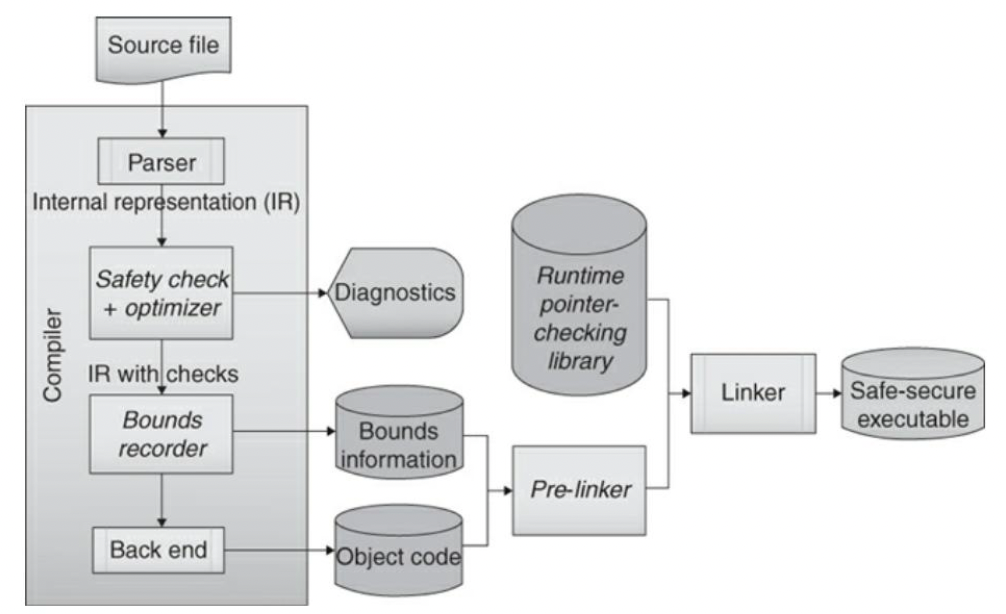
- 가능한 Safe-Secure C/C++ (SSCC) implementation
Notable Vulnerabilities
- Remote Login (rlogin)
- Buffer overflow:
TERM environment variable을 local stack variable로 선언된 1,024 characters array로 복사
- Buffer overflow:
- Kerberos
- Network authentication protocol
- http://web.mit.edu/Kerberos/
krb_rd_req()함수에서 buffer overflow- 공격자가 네트워크를 통해 root access 얻을 수 있음.
Summary
- C 및 C++에서 buffer overflows가 자주 발생하는 이유
- Strings를 null-terminated arrays of characters로 정의
- 암묵적인 bounds checking을 수행하지 않음.
- Bounds checking을 강제하지 않는 표준 라이브러리 호출 제공
- 일반적인 완화 전략은 새로운 라이브러리 채택
- 실용적인 완화 전략은 static analysis 및 dynamic analysis 포함
- Runtime solutions
- Bounds checkers, canaries, safe libraries
- Defense-in-depth strategy
시험 정보
장소: 501호